Second Point's active view on German industrial capex and the export-manufacturing complex.
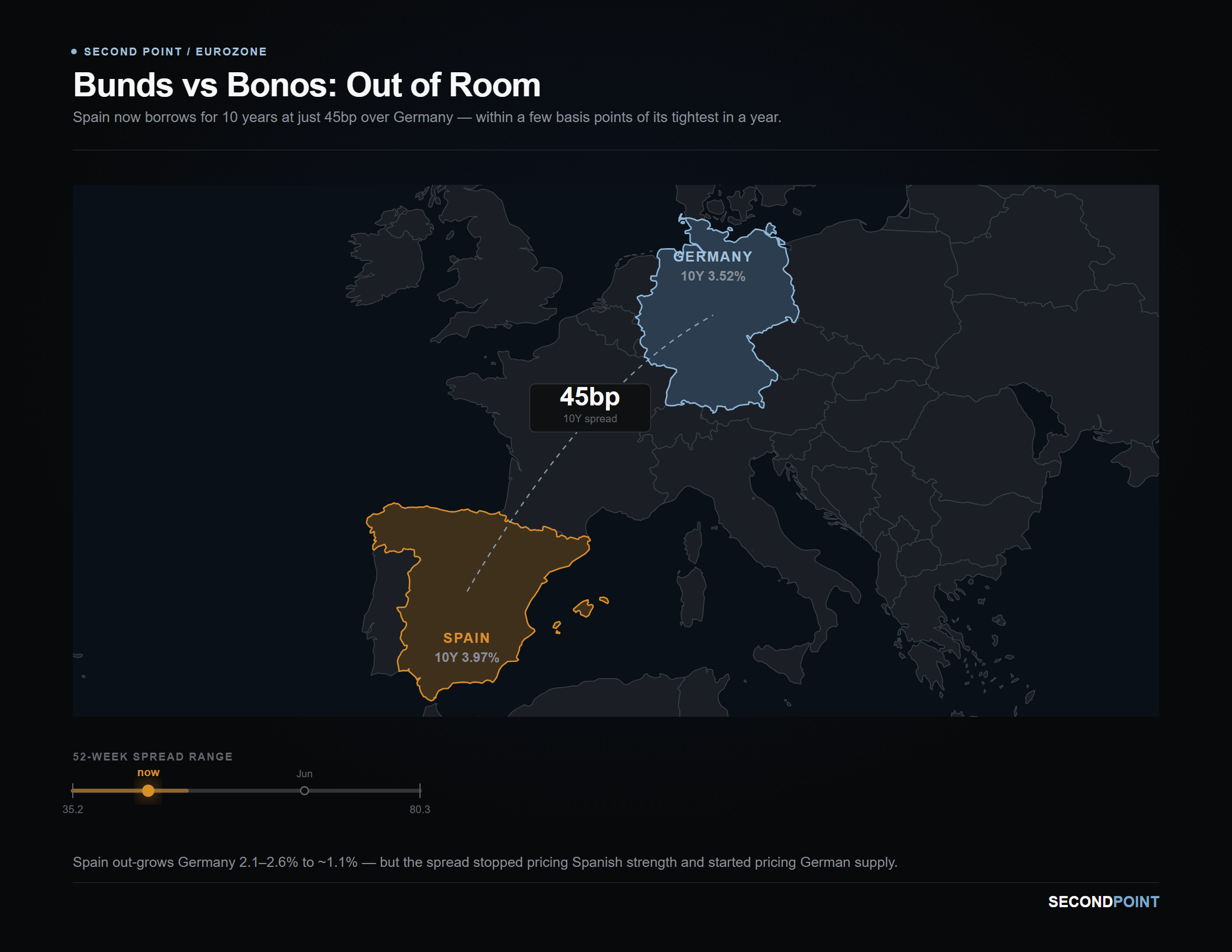
Own Bunds against Spanish Bonos — the spread is near its 52-week tight, and the compression is being driven by German weakness rather than Spanish strength.
The German–Spanish 10-year spread — the extra yield Spain pays over Germany to borrow for the same length of time — has compressed from about 65bp in early June to roughly 45bp, against a 52-week range of 35.2–80.3bp. Consensus reads that as Spain’s growth story, and the growth gap is real. But the move since June has been driven at least as much by Germany deteriorating: Chancellor Merz’s debt-funded package is raising Bund supply, and the 6 September Saxony-Anhalt election delivered 43.8% to the AfD while cutting the CDU to 17.2%. A spread tightening because the benchmark is getting worse is a fragile reason for it to keep tightening.
ECB meeting 29 October, with roughly 61% odds of a further hike priced after the 10 September move to a 2.50% deposit rate. Euro-area August CPI hit 3.3%, a three-year high. Germany’s Q4 issuance calendar is the other swing factor.
If the spread breaks below 35.2bp and holds for a week, compression is not exhausted and the fade is wrong. A material rise in German Q4 issuance would cheapen Bunds further and cut against the trade. WTI holding above $110 for two-plus weeks would push import-bill stress high enough that Spain’s energy-light economy dominates again. One open item: the German Q4 issuance calendar could not be confirmed in any source — it is load-bearing here and needs verifying before sizing.