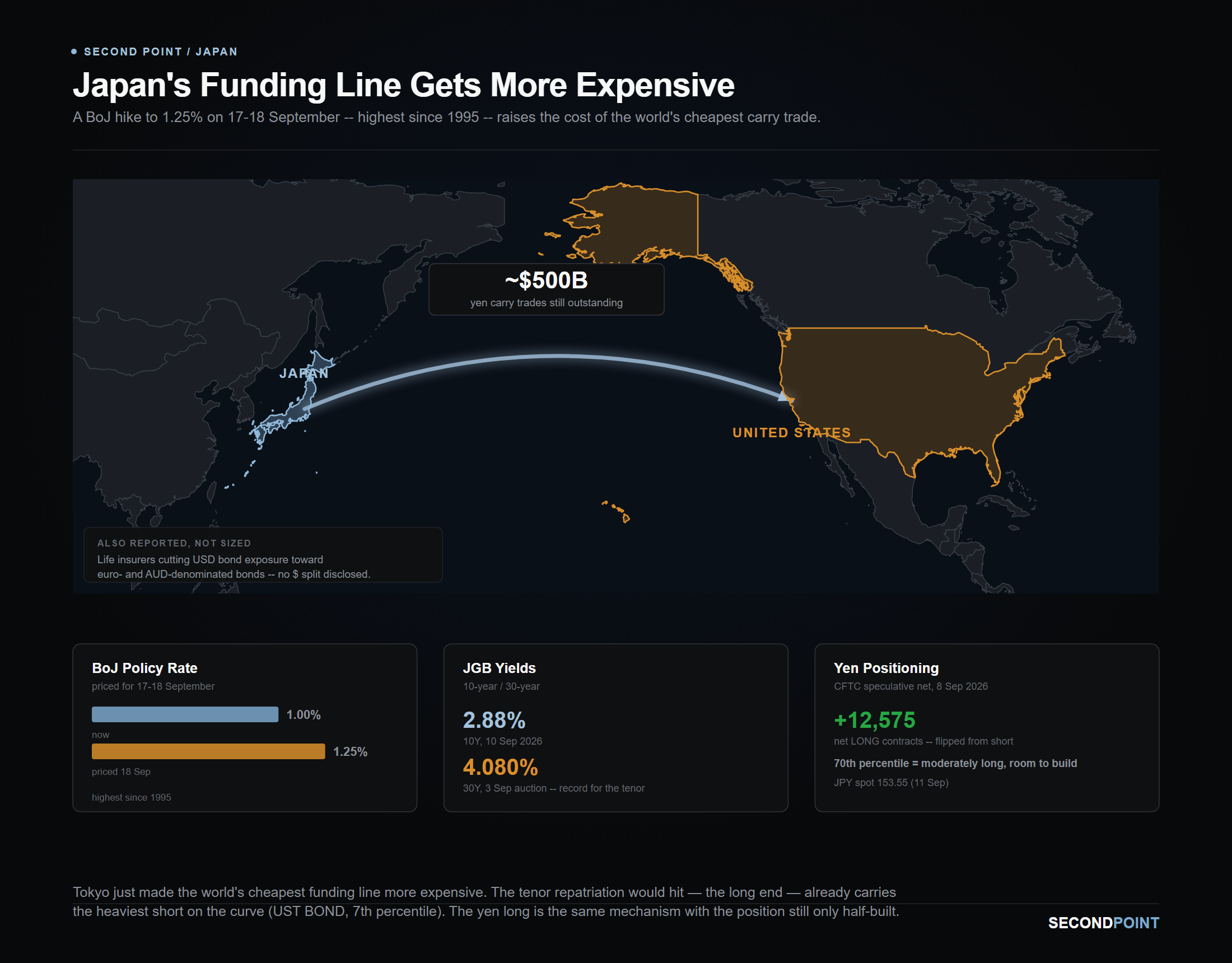
Second Point's active view on JGB curve dynamics under BoJ policy normalization.
Long yen into the Bank of Japan’s hike to 1.25% — the carry unwind is live, and yen positioning is the uncrowded way to own it.
The Bank of Japan is set to raise its policy rate to 1.25% on 17–18 September, the highest since 1995, while Japanese government bond yields sit at multi-decade highs — the 10-year near 2.88% and the 30-year at 4.080% at the 3 September auction, a record for that tenor since 1999. The carry trade — borrowing cheaply in yen to buy higher-yielding assets abroad — is unwinding in real time. The popular extension of that idea is that Japan repatriates capital and US Treasuries get sold next — and the tenor that would absorb those flows is already heavily short: CFTC net-short positioning in UST BOND and ULTRA UST BOND sits at the 7th percentile of its 52-week range, close to the most-short reading of the year. (Front-end 2Y and 5Y shorts, by contrast, have been covered and are light.) Yen positioning is the opposite — it has only just flipped net long, at +12,575 contracts after a 108,356-contract weekly swing, and sits at just the 70th percentile of its 52-week range. Same mechanism, far more room.
BoJ decision 17–18 September; national CPI released 18 September. The BoJ has also slowed its balance-sheet taper to ¥200bn per quarter from ¥400bn since April, while life insurers have been selling ultra-long JGBs and the Ministry of Finance has planned supply cuts at the long end.
**Correction (2026-09-12):** an earlier version of this page read the CFTC 52-week percentile as if a high number meant a crowded short. It means the opposite for a net-short contract. The positioning text below has been corrected; the resulting call is under review and has not yet been re-derived from the corrected data. A hold at 1.00% on 18 September would likely reverse the yen’s gains and unwind the recent short-covering. A 30-year JGB break above 4.20% on a weak auction, with a bid-to-cover under 3.52x, would signal official support is insufficient and a larger dislocation is building. If CFTC yen positioning crosses the 90th percentile the trade is crowded — take profit rather than add. And if the Treasury short unwinds below the 70th percentile, the setup for any delayed repatriation leg changes.