Second Point's active view on Gulf supply risk, war-premium transmission, and the shipping and insurance channels the conflict actually reprices.
Gulf petrostates are getting richer while their own bonds get crushed — avoid extending duration in Gulf USD paper until Hormuz flows normalise.
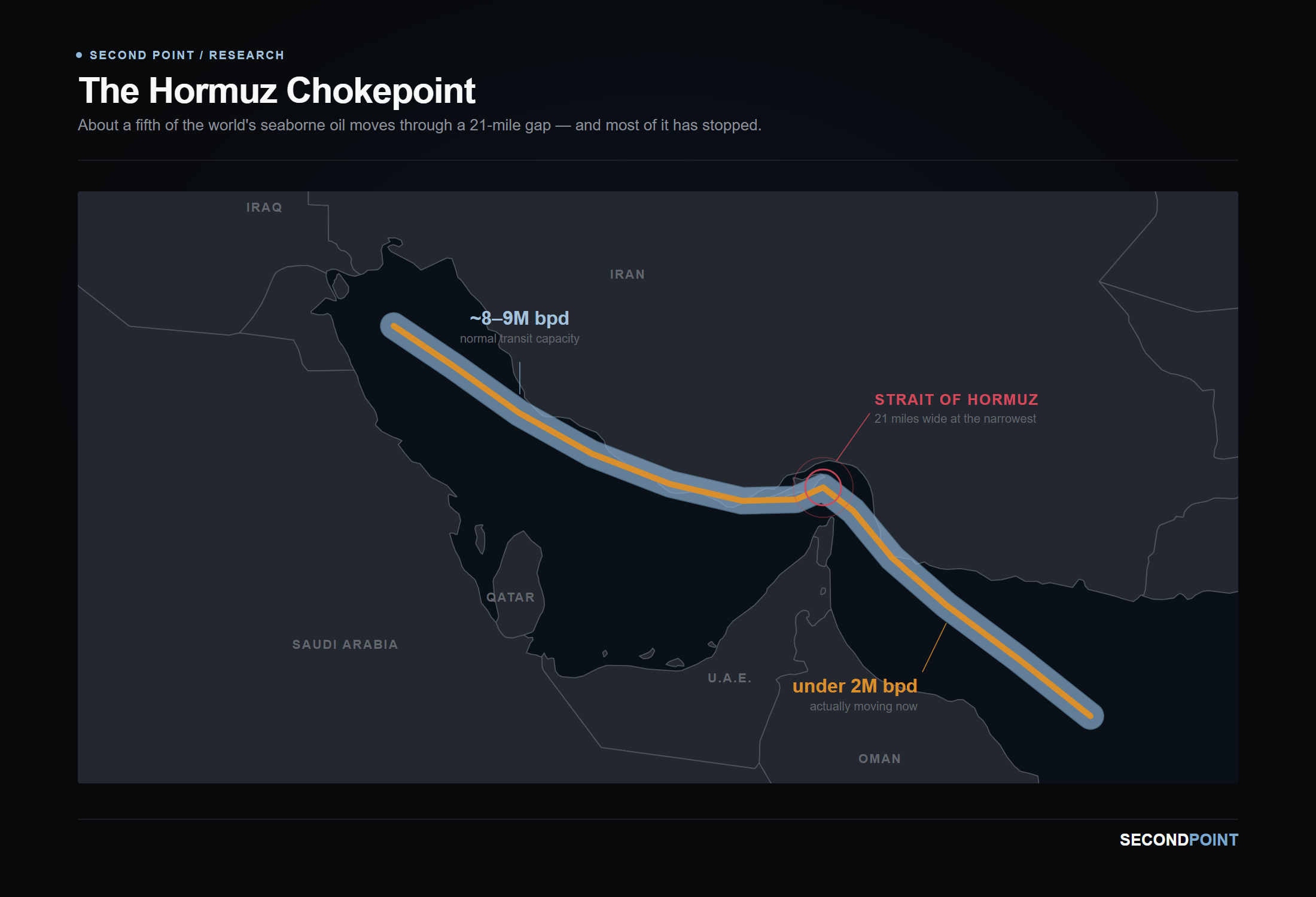
Oil at $100.05 WTI and $104.61 Brent is a war premium, not a supply-cycle move: Strait of Hormuz flows have collapsed from roughly 8–9 million barrels a day to under 2 million amid an active US–Iran conflict, and the IEA has cut its 2026 global supply forecast by 6%. OPEC+ has already finished unwinding its 2023 cuts and held October output flat, so no spare capacity is queued behind this. Consensus calls the Gulf the obvious winner, and on revenue it is. But the bonds are pricing the war, not the windfall — Saudi 30-year paper is down 8.5% on price, Qatar 10.3%, Oman 6.9% — hit simultaneously by rising Treasury yields and the same conflict lifting the oil price. That disconnect is the more interesting trade than anything in the oil price itself.
OPEC+ meetings and any change in Hormuz transit volumes are the live catalysts. Crucially, CFTC positioning shows this is not a crowded move: WTI Financial net-spec length sits at the 78th percentile and Light Sweet WTI at just the 24th, so escalation risk is not yet in the price despite a 20% one-month rally.
A confirmed, dated Hormuz ceasefire — not merely a pause — would compress Gulf spreads toward pre-war levels and pull oil down at once, invalidating this outright. Abu Dhabi’s 10-year spread reverting toward its January level of 27bp, from 48bp now, would show the market has stopped pricing existential risk. CFTC WTI positioning crossing the 90th percentile would flip the crowding read. Access note: these bonds trade mainly in institutional size under Reg S/144A and are not realistically reachable for a retail account — the listed KSA and UAE vehicles are equity ETFs, not the sovereign bonds.