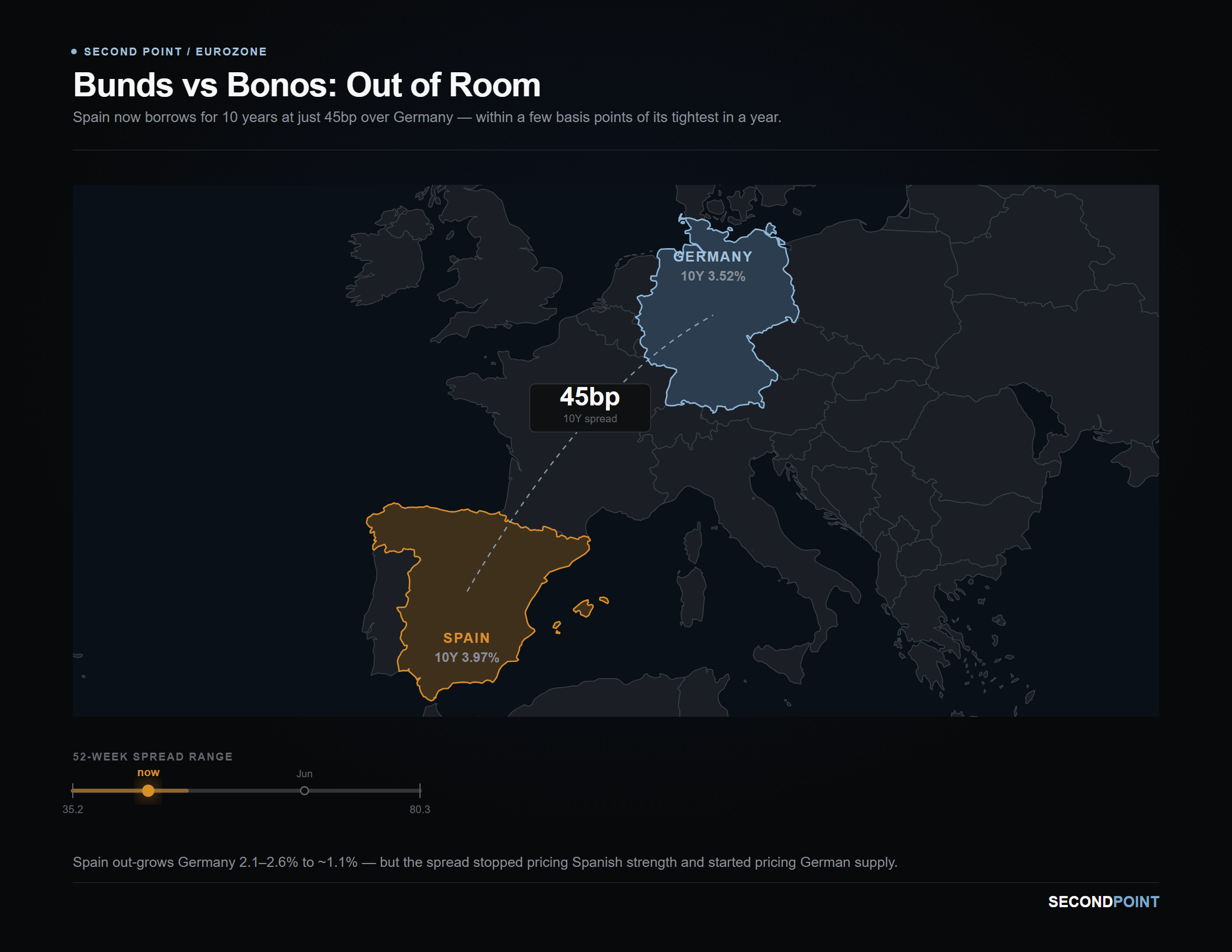
Second Point's active view on Spanish sovereign spreads within the eurozone periphery.
Spain’s growth premium is real and now largely in the price — at roughly 45bp over Germany, near the 52-week tight, the Bono is the leg to fade.
Spain is the one large euro-area economy genuinely growing: 2026 forecasts put GDP at 2.1–2.6% against roughly 1.1% for the bloc, powered by services — tourism, hospitality, logistics — that make up about 74% of the economy and insulate it from the manufacturing recession hitting Germany. Equities agree: Spain’s EWP is down just 1.1% over 30 days versus Germany’s EWG at −2.3%, and up 8.2% over 90 days versus 3.5%. The divergence is not in doubt. The question is how much is left to price, and with the spread to Germany within a hair of its 52-week low, the answer is probably not much — especially since the recent compression came from German supply and politics rather than from Spain improving further.
ECB meeting 29 October, with roughly 61% odds of a hike priced after the 10 September move to a 2.50% deposit rate. Into Q4, watch for a tourism-season fade and any Spanish coalition wobble — either would be the idiosyncratic catalyst the widening case needs.
A break below 35.2bp held for a week kills the fade. WTI above $110 for two-plus weeks favours Spain’s energy-light economy over Germany’s industrial base and would push the spread tighter still. Both countries are net energy importers, so the oil shock itself is a bloc-wide headwind rather than a divergence driver — it decides who absorbs it better, not who wins.