Second Point's active view on GBP and UK external-balance dynamics.
Fade the crowded short in long gilts into the 28 October Budget — the 2022 pension mechanism everyone is pricing has been substantially defused.
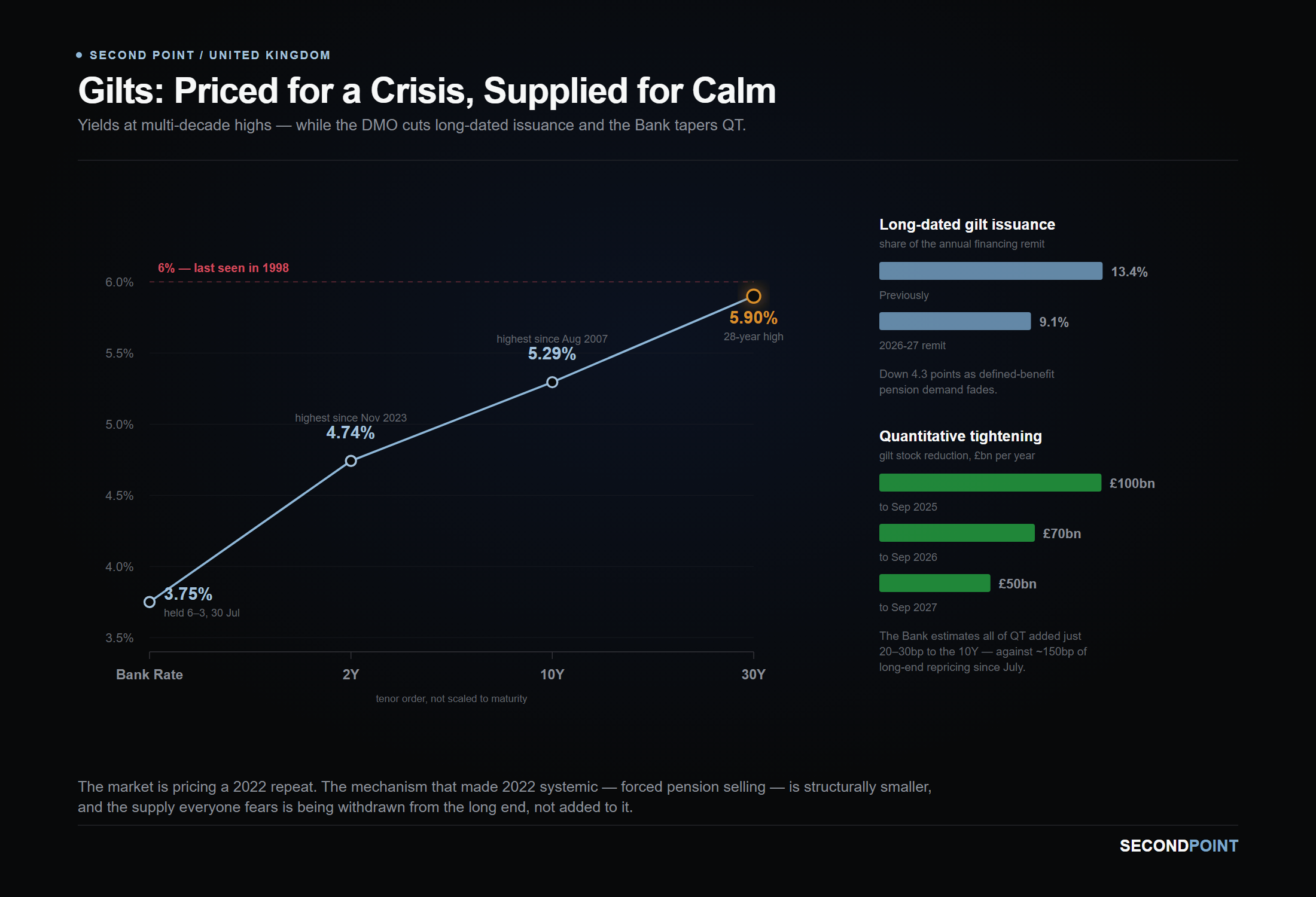
The UK long end is priced for a fiscal crisis everyone can already see: 30-year gilts near 5.9%, a 28-year high pressing toward levels last seen in 1998, with the 10-year at 5.295% (highest since 2007) and the 2-year at 4.742%. Gilts sold off when Andy Burnham became Prime Minister on 20 July and named John Healey — a defence hawk rather than a Treasury austerity figure — as Chancellor, and the move has not stopped. That is a first-order read, fully telegraphed. The second-order question is whether the mechanism that made 2022 an actual crisis — forced selling by pension funds amplifying the sell-off — still exists at the same strength. Two things say it is smaller: pension funds have de-risked with larger collateral buffers, and the DMO pre-emptively cut long-dated issuance to about 9.1% of the 2026-27 remit, down 4.3 points, on structurally weaker demand. Supply and demand have both moved away from the 2022 fragility while the yield sits right on top of it.
The Autumn Budget on 28 October is the event this is built around — a credible, OBR-scored package would punish the crowded short, with the long end scarcest on supply. Bank of England decision 17 September, with roughly 90% consensus for a hold.
Conviction here is deliberately Low; this is an event-defined fade, not a view that UK fiscal policy is sound. A 30-year close above 6.00% on UK-specific rather than global drivers kills it. Budget headroom scored below about £10bn, or a post-Budget yield spike instead of a rally, confirms the bearish consensus. Any reappearance of LDI margin calls means the de-risked-pension assumption has failed outright. Worth watching separately: sterling has not rallied despite higher yields, which suggests the market is pricing a credit discount rather than a rate advantage.